ChatGPT vs. Perplexity vs. Google AI Overviews: What's the Difference and Why It Matters
By Garry M. Callis Jr.
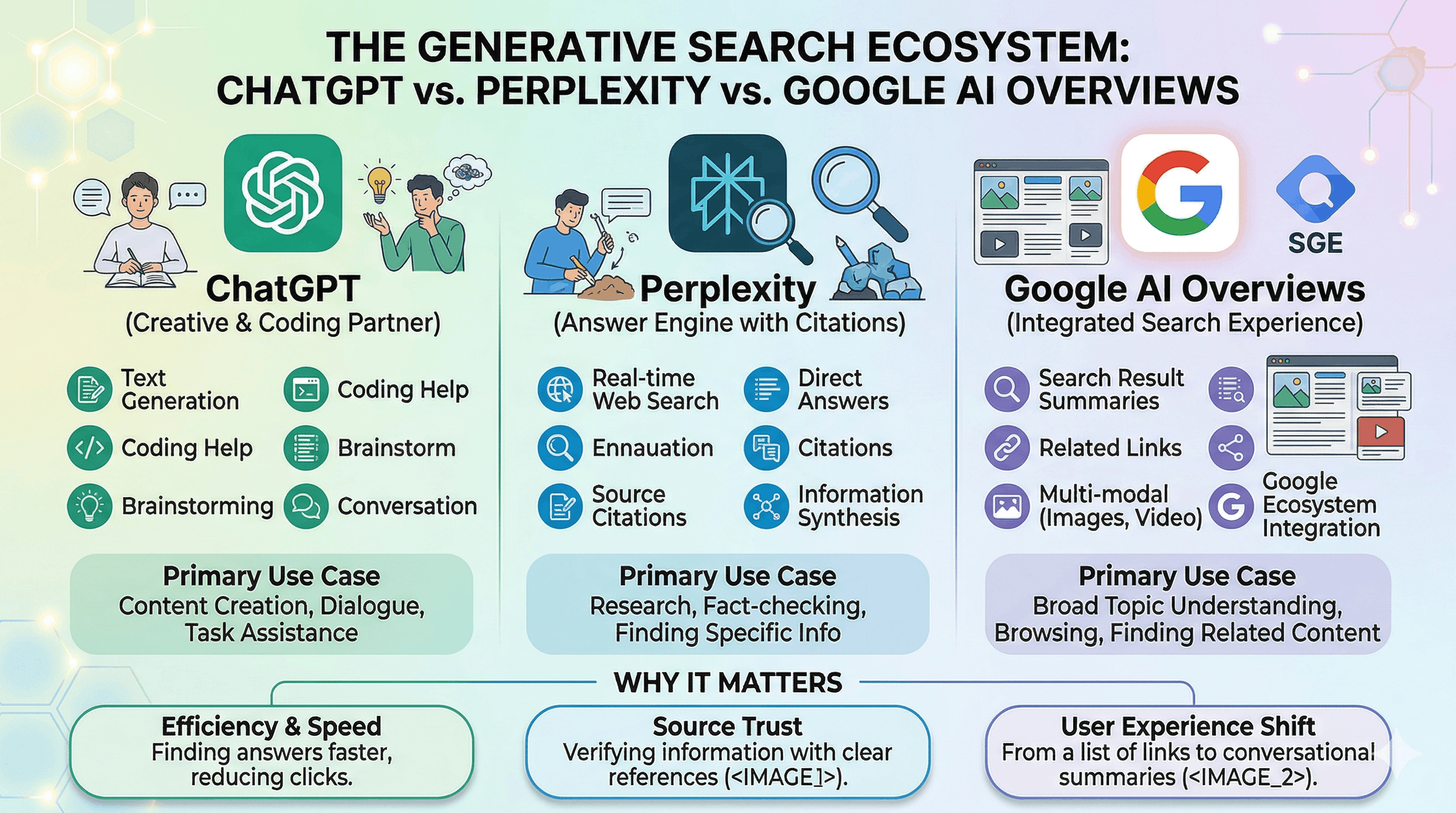
People only use ChatGPT, mainly because they don't know there are other Large Language Models out there that can handle different tasks in different ways.
<p></p><p>Most people who use ChatGPT, Perplexity, or Google's AI Overviews assume they're all doing roughly the same thing, taking a question and producing an answer. That assumption is costing businesses visibility they don't even know they're losing.</p><p>These three platforms are not interchangeable. They retrieve information differently, evaluate sources differently, and reward different kinds of content. If your strategy treats them as one, you're likely optimizing for none of them.</p><p>This article breaks down what each platform actually does, why those differences matter, and what it means for anyone who creates content or runs a business that depends on being found.</p><p></p><h1><strong>First, The Thing They All Have In Common</strong></h1><p>All three platforms are generative engines. When a user asks a question, they don't return a list of links and ask the user to choose. They synthesize an answer and deliver it directly. The user gets information without necessarily visiting a single website.</p><p>That shared behavior is what makes this era different from traditional search. The question is no longer just "do you rank?" It's whether your content gets selected as source material for the answer someone receives.</p><table style="min-width: 25px;"><colgroup><col style="min-width: 25px;"></colgroup><tbody><tr><td colspan="1" rowspan="1"><p><strong>What is a generative engine?</strong></p><p>Any AI-powered system that interprets a user's question and generates a synthesized response, rather than returning a ranked list of links. ChatGPT, Perplexity, and Google AI Overviews are all generative engines, but they work in meaningfully different ways.</p></td></tr></tbody></table><p><br></p><p></p><h1><strong>ChatGPT: The World's Most-used LLM, and The One Most People Misunderstand</strong></h1><img src="https://access.discoveraio.com/storage/v1/object/public/public-assets/email-images/image_2026-03-31_112652286.png" alt="" class="editor-image max-w-full h-auto rounded-lg cursor-pointer transition-all hover:opacity-80" draggable="false" style="max-width: 100%; height: auto;"><p>ChatGPT is the dominant platform in this space by a wide margin. <a target="_blank" rel="noopener noreferrer nofollow" class="text-primary underline" href="https://techcrunch.com/2025/10/06/sam-altman-says-chatgpt-has-hit-800m-weekly-active-users/"><u>OpenAI reported 800 million weekly active users</u></a> in October 2025, a number that has since grown further. For scale: that's more people than the combined populations of the United States, the EU, and Canada interacting with a single platform every week.</p><p>But the most important thing to understand about ChatGPT is what it actually does when you ask it a question.</p><h2><strong>How ChatGPT Works</strong></h2><p>In its default state, ChatGPT does not search the internet. It generates answers from its training data, an enormous corpus of text it was trained on up to a specific cutoff date. When you ask it something, it reconstructs an answer from patterns learned during training, not from live web content.</p><p>That changes when web browsing is enabled, which is available to Plus and higher-tier users. When browsing is on, ChatGPT can search the web in real time and incorporate current content into its responses. But even then, it approaches the web differently than Perplexity does, more selectively, less transparently, and without always showing which sources it drew from.</p><h2><strong>What ChatGPT Rewards</strong></h2><p>Because ChatGPT's default mode draws from training data, the path to visibility there is longer-term and more foundational than on Perplexity. The factors that influence whether your brand or content gets surfaced:</p><ul><li><p>Clear, definitional writing: ChatGPT frequently pulls from content that opens with an explicit definition. Sentences structured as "[Term] is [definition]" are among the most commonly reproduced formats</p></li><li><p>Consistent topical presence: if your brand appears across multiple credible sources covering a topic, that pattern is more likely to influence how ChatGPT discusses that topic</p></li><li><p>Author and domain authority: content from credentialed authors and established domains carries more weight in training data</p></li><li><p>Structured, extractable content: well-organized pages with clear headings and standalone paragraphs are easier for the model to learn from</p></li></ul><table style="min-width: 25px;"><colgroup><col style="min-width: 25px;"></colgroup><tbody><tr><td colspan="1" rowspan="1"><p><strong>ChatGPT in plain terms</strong></p><p>Think of ChatGPT as a highly educated colleague who read everything on the internet up to a certain date, then went offline. When you ask it something, it answers from memory. Occasionally, it checks the web, but it's still fundamentally drawing on what it already knows. Getting your content into that knowledge base is a long game, built on authority, consistency, and clarity.</p></td></tr></tbody></table><p><br></p><p></p><h1><strong>Perplexity: The Citation Engine Built for Researchers</strong></h1><img src="https://access.discoveraio.com/storage/v1/object/public/public-assets/email-images/image_2026-03-31_112750812.png" alt="" class="editor-image max-w-full h-auto rounded-lg cursor-pointer transition-all hover:opacity-80" draggable="false" style="max-width: 100%; height: auto;"><p>Perplexity is the most misunderstood of the three platforms — often lumped in with ChatGPT despite working in a fundamentally different way. Where ChatGPT defaults to memory, Perplexity defaults to search.</p><p>Every query on Perplexity triggers a live web search. The platform retrieves current sources, synthesizes an answer, and critically, shows the user exactly where the information came from via inline, clickable citations. <a target="_blank" rel="noopener noreferrer nofollow" class="text-primary underline" href="https://aibusinessweekly.net/p/perplexity-ai-statistics"><u>Perplexity processed 780 million queries in May 2025</u></a>, tripling from 230 million just a year earlier.</p><h2><strong>How Perplexity Works</strong></h2><p>When a user submits a query, Perplexity performs a real-time web search, identifies the most relevant and authoritative sources, extracts key passages, and synthesizes a response. Every claim in that response carries a numbered citation the user can click to verify.</p><p>This design makes Perplexity the most transparent of the three platforms. Users can see exactly which sources were used, which makes citation in Perplexity directly traceable, and directly valuable for driving traffic back to your site.</p><p>According to <a target="_blank" rel="noopener noreferrer nofollow" class="text-primary underline" href="https://www.perplexity.ai/help-center/en/articles/10352895-how-does-perplexity-work"><u>Perplexity's own help documentation</u></a>, the platform is designed so that every answer includes citations linking to the original sources, making it straightforward for users to verify information or explore further.</p><h2><strong>What Perplexity Rewards</strong></h2><ul><li><p>Recency: Perplexity searches the live web for every query, which means fresh, recently published content has an immediate advantage over older material</p></li><li><p>Specificity: content that answers a precise question outperforms broad overviews. Perplexity matches specific questions to specific answers</p></li><li><p>Quantified claims: specific statistics with clear attribution are cited far more frequently than vague assertions</p></li><li><p>Structured content: question-based headings, clean paragraph structure, and FAQ sections all improve citation likelihood</p></li></ul><table style="min-width: 25px;"><colgroup><col style="min-width: 25px;"></colgroup><tbody><tr><td colspan="1" rowspan="1"><p><strong>Perplexity in plain terms</strong></p><p>Think of Perplexity as a research assistant who reads the internet on your behalf every time you ask a question — then reports back with receipts. If your content is current, specific, and clearly structured, Perplexity will find it. And when it cites you, users can click directly to your site.</p></td></tr></tbody></table><p><br></p><p></p><h1><strong>Google AI Overviews: The Incumbent that Changed its Own Game</strong></h1><img src="https://access.discoveraio.com/storage/v1/object/public/public-assets/email-images/image_2026-03-31_113128937.png" alt="" class="editor-image max-w-full h-auto rounded-lg cursor-pointer transition-all hover:opacity-80" draggable="false" style="max-width: 100%; height: auto;"><p>Google AI Overview, the AI-generated response that now appears above traditional search results for many queries, is the platform most people encounter without realizing it. Unlike ChatGPT and Perplexity, which require users to actively open a separate tool, Google AI Overviews appear automatically inside the search experience billions of people already use.</p><p>The scale of their impact is already measurable. <a target="_blank" rel="noopener noreferrer nofollow" class="text-primary underline" href="https://www.seerinteractive.com/insights/aio-impact-on-google-ctr-september-2025-update"><u>Research from Seer Interactive</u></a>, analyzing 25.1 million impressions across 42 organizations, found that organic click-through rates for queries with AI Overviews present dropped 61% between June 2024 and September 2025. Users are getting their answers inside Google without clicking through to any website.</p><p>The same research found a clear counterpoint: brands cited inside AI Overviews saw 35% higher organic click-through rates than brands that weren't cited on the same queries. Being in the answer is now more valuable than being below it.</p><h2><strong>How Google AI Overviews Work</strong></h2><p>Unlike Perplexity, which treats every query as a fresh web search, Google AI Overviews draw from Google's existing search index. Google has already crawled and evaluated the content, AI Overviews then synthesize responses from that indexed material using Google's established quality signals.</p><p>That means Google AI Overviews are more dependent on traditional SEO foundations than the other two platforms. Content that already ranks well in organic search has a higher baseline probability of appearing in AI Overviews. But ranking is not sufficient on its own, the content must also be structured in a way that lends itself to AI synthesis.</p><h2><strong>What Google AI Overviews Reward</strong></h2><ul><li><p>Traditional SEO foundations: strong domain authority, quality backlinks, and organic rankings remain prerequisite conditions for AI Overview inclusion.</p></li><li><p>E-E-A-T signals: Experience, Expertise, Authoritativeness, and Trustworthiness are even more important in the AIO era than before.</p></li><li><p>Structured data: FAQ schema, HowTo schema, and Article schema help Google understand content type and context, which directly influences AIO inclusion.</p></li><li><p>Conversational question formats: content structured around the questions people actually ask performs significantly better than content organized around keywords.</p></li><li><p>Content freshness: regularly updated content with visible publication and update dates is weighted more heavily for time-sensitive queries. The <a target="_blank" rel="noopener noreferrer nofollow" class="text-primary underline" href="https://xponent21.com/insights/the-good-farmer-seo-method/">Good Farmer SEO</a> tactic we discuss in a lot of our articles is applicable here. </p></li></ul><table style="min-width: 25px;"><colgroup><col style="min-width: 25px;"></colgroup><tbody><tr><td colspan="1" rowspan="1"><p><strong>Google AI Overviews in plain terms</strong></p><p>Think of Google AI Overviews as Google's editorial team, drawing from the library it has already built, then writing a summary on top of it. The path in starts with traditional SEO. The path to staying in requires content that's structured clearly enough for AI to extract and use directly.</p></td></tr></tbody></table><p><br></p><p></p><h1><strong>How the Three Platforms Compare</strong></h1><p>Here is a side-by-side view of what separates the three platforms across the dimensions that matter most for content visibility:</p><p><br></p><table style="min-width: 100px;"><colgroup><col style="min-width: 25px;"><col style="min-width: 25px;"><col style="min-width: 25px;"><col style="min-width: 25px;"></colgroup><tbody><tr><td colspan="1" rowspan="1"><p></p></td><td colspan="1" rowspan="1"><p><strong>ChatGPT</strong></p></td><td colspan="1" rowspan="1"><p><strong>Perplexity</strong></p></td><td colspan="1" rowspan="1"><p><strong>Google AIO</strong></p></td></tr><tr><td colspan="1" rowspan="1"><p><strong>Source of answers</strong></p></td><td colspan="1" rowspan="1"><p>Training data + optional web search</p></td><td colspan="1" rowspan="1"><p>Real-time web, always</p></td><td colspan="1" rowspan="1"><p>Google's index, real-time synthesis</p></td></tr><tr><td colspan="1" rowspan="1"><p><strong>Shows citations?</strong></p></td><td colspan="1" rowspan="1"><p>Sometimes (with browsing on)</p></td><td colspan="1" rowspan="1"><p>Always — inline and clickable</p></td><td colspan="1" rowspan="1"><p>Sometimes, with source links</p></td></tr><tr><td colspan="1" rowspan="1"><p><strong>Best for</strong></p></td><td colspan="1" rowspan="1"><p>Reasoning, writing, explanation</p></td><td colspan="1" rowspan="1"><p>Research, fact-finding, recency</p></td><td colspan="1" rowspan="1"><p>Quick answers on familiar topics</p></td></tr><tr><td colspan="1" rowspan="1"><p><strong>Crawls the web?</strong></p></td><td colspan="1" rowspan="1"><p>Only when browsing is enabled</p></td><td colspan="1" rowspan="1"><p>Every query, by default</p></td><td colspan="1" rowspan="1"><p>Continuously, via Google index</p></td></tr><tr><td colspan="1" rowspan="1"><p><strong>GEO priority</strong></p></td><td colspan="1" rowspan="1"><p>Definitional clarity, authority</p></td><td colspan="1" rowspan="1"><p>Recency, specificity, structure</p></td><td colspan="1" rowspan="1"><p>Traditional SEO + E-E-A-T + schema</p></td></tr></tbody></table><p><br></p><p></p><h1><strong>Why These Differences Matter For Your Business</strong></h1><p>The practical implication of all three platforms existing simultaneously is that there is no single optimization strategy that covers all of them. What works for Perplexity, highly current, specific, citation-rich content, is not what ChatGPT's training data rewards. What Google AI Overviews require, strong organic foundations and structured data, is a different investment than what Perplexity surfaces within hours of publication.</p><p>This does not mean you need three completely separate content strategies. The fundamentals overlap: clear writing, genuine expertise, structured formatting, specific claims, and credible authorship all improve your chances across all three. But understanding the distinctions helps you prioritize where to focus first and what type of content to build around which platform.</p><table style="min-width: 25px;"><colgroup><col style="min-width: 25px;"></colgroup><tbody><tr><td colspan="1" rowspan="1"><p><strong>The one thing that matters on all three platforms</strong></p><p>Every one of these platforms is evaluating whether your content can be extracted and used to answer a specific question clearly and accurately. Content that hedges, generalizes, or buries its key point isn't useful to any of them. Write like someone who knows the answer, and state it directly.</p></td></tr></tbody></table><p><br></p><p></p><h1><strong>Go deeper on the Discover AIO Complete Guide to GEO</strong></h1><p>This article covers the what and why. The how, the platform-by-platform optimization tactics, the Citation Readiness Audit, the structured data implementation framework, and the GEO measurement system, lives in the Complete Guide to GEO on Discover AIO.</p><table style="min-width: 25px;"><colgroup><col style="min-width: 25px;"></colgroup><tbody><tr><td colspan="1" rowspan="1"><p>Access the Complete Guide to GEO with a membership at <a target="_blank" rel="noopener noreferrer nofollow" class="text-primary underline" href="http://discoveraio.com"><u>discoveraio.com</u></a>. Not a member yet? Explorer is free. And the <a target="_blank" rel="noopener noreferrer nofollow" class="text-primary underline" href="https://discoveraio.com/directory"><u>Member Directory</u></a> connects you with practitioners already implementing GEO across all three platforms in real businesses.</p></td></tr></tbody></table><p></p>