Citability: The Metric that Replaces Rankings in AI Search
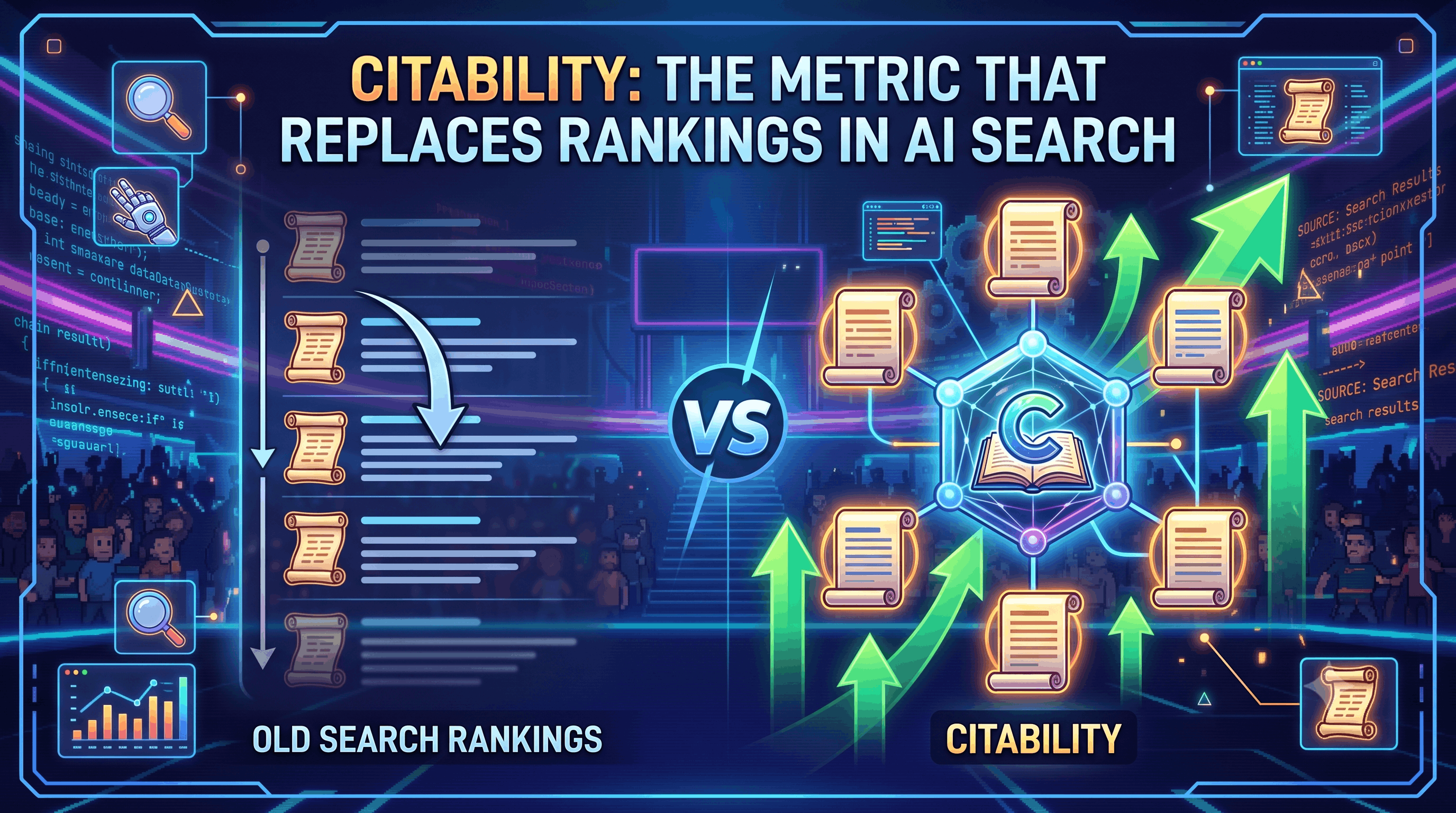
The landscape of AI search is about citation. This article breaks down what citation is, and how AI looks at your content to tell if you're reliable or not,
<h2><strong>Key Takeaways</strong></h2><ul><li><p>Citability measures how consistently AI engines reference your content when generating answers, it's the metric that matters in AI search, separate from ranking.</p></li><li><p>Getting cited runs on two engines simultaneously: on-site structure and authority, and off-site presence on the sources AI trusts.</p></li><li><p>On-site, lead each section with the direct answer, structure for extraction, include authority signals in the content, and write something only you can write.</p></li><li><p>Off-site, citations go to brands described consistently and favorably across several independent sources, communities, reviews and third-party publications.</p></li><li><p>AI engines evaluate content for factual verifiability, passage-level clarity and corroboration across sources. Generic content that restates what's widely available rarely gets cited.</p></li><li><p>Earn it authentically. Manufactured mentions violate policy and read as fake to the systems you are trying to influence.</p></li><li><p>Measure citation performance with a fixed prompt set run monthly, or the work stays invisible.</p></li></ul><p></p><p>Ranking in AI search and being cited in AI search are two different outcomes. A page can sit at position one and never appear in an AI-generated answer. A page outside the top ten can be cited repeatedly. The signal AI engines use to decide what to reference is not position, it's citability.</p><p>Citability measures how consistently and dependably AI models reference specific content when generating responses. It reflects whether your content is trustworthy enough, clear enough and specific enough to serve as a factual basis for an AI-generated answer. Unlike traditional SEO, which optimizes for keyword matching and backlink profiles, citability optimizes for factual authority and passage-level extractability.</p><p>Getting cited by AI search engines runs on two engines at once: what your own page says, and what the rest of the web says about you. The first half earns eligibility. The second half earns the recommendation. Most teams do the first and skip the second, which is why they rank and still go uncited.</p><p>We covered why a well-ranked page can still be invisible to AI in "<a target="_blank" rel="noreferrer" class="text-primary underline text-[var(--accent)] hover:underline underline-offset-[1px] outline-none hide-focus-ring ring-focus rounded-r2" href="https://discoveraio.com/articles/why-your-brand-doesnt-appear-in-ai-overviews-ahrefs-explains">Why Your Brand Doesn't Appear in AI Overviews</a>." This piece is the affirmative playbook for earning the citation.</p><p></p><h2><strong>How AI Engines Identify Citable Content</strong></h2><img src="https://access.discoveraio.com/storage/v1/object/public/public-assets/email-images/Your_paragraph_text__6_.png" alt="" class="editor-image max-w-full h-auto rounded-lg cursor-pointer transition-all hover:opacity-80" draggable="false" style="max-width: 100%; height: auto;"><p>AI engines don't cite sources arbitrarily. They evaluate content against a set of criteria before pulling from it, and understanding those criteria is the starting point for building citability deliberately.</p><p>The signals AI systems weight most heavily:</p><p><strong>Direct answers to specific questions.</strong> AI engines scan for passages that answer a query cleanly, without requiring surrounding context. A passage that opens with the answer and then supports it is far more extractable than one that buries the answer in paragraph three.</p><p><strong>Factual verifiability.</strong> Content that contains specific data points, named examples and attributable claims is more citable than content built on generalizations. "Companies using structured data see improved AI citation rates" is weak. "<a target="_blank" rel="noopener noreferrer nofollow" class="text-primary underline" href="https://ahrefs.com/blog/ai-overview-citations-top-10/">Ahrefs' analysis of 300,000 AI Overview citations</a> found that 62% of cited sources fall outside the top 10 organic results for the same query" is citable, specific, attributed and verifiable.</p><p><strong>Corroboration across sources.</strong> AI models cross-reference. When the same claim, description or fact appears across multiple independent sources, the model gains confidence in it and is more likely to surface it. A brand described the same way on a review platform, in a community thread and in a publication tells a consistent story the model can trust.</p><p><strong>Topical authority, not just page authority.</strong> A single strong article on a topic is a weaker citation signal than a content ecosystem that covers the topic from multiple angles. AI engines are more likely to cite sources that demonstrate sustained depth across a subject.</p><p><strong>Absence of contradictions.</strong> Outdated stats, claims that conflict with what other trusted sources say, and factual errors all reduce citability. AI systems penalize sources that have been found to be inaccurate. An old figure that contradicts current data is a liability, not just a weakness.</p><p></p><h2><strong>On-site: Make Your Content Easy to Extract and Trust</strong></h2><p>AI engines lift passages, so your first job is to make each answer self-contained and credible on the page itself. A model reaching into your content for a specific answer needs to find it fast and have a reason to trust it.</p><p>Four moves do most of the work:</p><ul><li><p><strong>Lead each section with the direct answer</strong>, then support it. The model skims for the answer, so put it first.</p></li><li><p><strong>Structure for extraction</strong> with clear headings, lists and tables, which lift more reliably than facts buried in prose.</p></li><li><p><strong>Put authority signals in the content</strong>, not just your domain profile: author credentials, original data, a visible last-updated date.</p></li><li><p><strong>Write something only you can write.</strong> Original framing, first-hand experience and proprietary data give a model something it cannot synthesize from ten other pages. Google's own guidance on generative AI optimization emphasizes that original, experience-grounded content earns citations at a higher rate than commodity content that reassembles what's already widely available.</p></li></ul><p></p><h2><strong>Off-site: Build Presence on the Sources AI Trusts</strong></h2><p>On-site work makes you eligible. Off-site presence tips an engine toward naming you, because AI systems lean heavily on third-party sources to decide which brands to recommend. Reviews, community discussions, independent publications and analyst coverage all feed the picture a model builds of your brand.</p><p>The pattern that earns citations is consistency: the same favorable description of your brand showing up across several independent sources. When a model sees you described the same way on a review platform, in a community thread and in a publication, it gains the confidence to surface you. We unpack the mechanics in "<a target="_blank" rel="noreferrer" class="text-primary underline text-[var(--accent)] hover:underline underline-offset-[1px] outline-none hide-focus-ring ring-focus rounded-r2" href="https://discoveraio.com/articles/the-backlink-is-not-the-big-man-on-the-ai-search-campus-anymore">Why the Backlink Isn't The Most Important Signal in AI Search Anymore</a>."</p><p></p><h2><strong>Earn it Authentically, Because the Shortcuts Backfire</strong></h2><p>The only durable path here is genuine. Google's guidance has retired the tactic of seeking inauthentic mentions, and AI engines weight community content precisely because it reads like real user experience. Manufactured reviews and planted threads violate platform policy and read as fake to the systems you are trying to influence.</p><p>A B2B software company that wants citations for "best onboarding tools" earns it the real way: they publish original onboarding benchmark data, answer onboarding questions genuinely in two communities their buyers use, and get one customer story placed in an industry publication. Over a couple of cycles, AI answers begin naming them, because every source the model checks tells the same credible story. That is earned citation, and it compounds.</p><p></p><h2><strong>Measuring Citability</strong></h2><p>Citability is invisible unless you measure it, and direct AI citation metrics are still maturing as a category. The practical approach for most teams right now is manual prompt tracking combined with whatever tooling is available.</p><p><strong>The core method:</strong> build a fixed set of 10-15 buyer questions that represent the queries your audience actually runs. Run those prompts across ChatGPT, Perplexity and Google AI Mode on a monthly cadence. Log whether you appear, whether you're cited with a source link, and which competitors appear in your place. Over three to four cycles, patterns emerge — which query types you're winning, which you're absent from, and where a specific competitor is consistently beating you.</p><p><strong>What to look for in the data:</strong></p><ul><li><p>Queries where you're mentioned but not cited with a link (AI trusts your brand but hasn't found a page clean enough to extract)</p></li><li><p>Queries where a competitor is cited and you're not (their content is better structured or their off-site presence is stronger for that topic)</p></li><li><p>Queries where you're absent entirely (a coverage gap, not just a structure problem)</p></li></ul><p><strong>Improving from the audit:</strong> the fixes map directly to the findings. Absent entirely usually means you need content. Mentioned but not linked usually means your existing content needs better passage structure, lead with the answer, tighten the section headings. Losing to a specific competitor usually requires both on-site improvement and off-site presence building on the platforms where that competitor has stronger coverage.</p><p>The full tracking method is covered in "<a target="_blank" rel="noreferrer" class="text-primary underline text-[var(--accent)] hover:underline underline-offset-[1px] outline-none hide-focus-ring ring-focus rounded-r2" href="https://discoveraio.com/articles/how-to-measure-your-visibility-in-ai-search">How to Measure Your AI Search Visibility</a>."</p><p></p><h2><strong>Frequently Asked Questions</strong></h2><img src="https://access.discoveraio.com/storage/v1/object/public/public-assets/email-images/AdobeStock_293471314.jpeg" alt="" class="editor-image max-w-full h-auto rounded-lg cursor-pointer transition-all hover:opacity-80" draggable="false" style="max-width: 100%; height: auto;"><h3><strong>What is Citability in AI Search?</strong></h3><p>Citability measures how consistently AI models reference specific content when generating responses. It reflects whether your content is trustworthy, clear and specific enough to serve as a factual basis for an AI-generated answer. Unlike traditional SEO metrics like rankings and traffic, citability measures direct AI engagement with your content as a source.</p><h3><strong>How Do I Get My Content Cited by ChatGPT or Perplexity?</strong></h3><p>Make your content easy to extract and trust on your own site, then build genuine presence on the third-party sources those engines pull from, especially communities and reviews. Citations tend to go to brands described consistently and favorably across several independent sources, not to the page with the highest keyword ranking.</p><h3><strong>Does My Content Need to Rank to be Cited by AI?</strong></h3><p>Not necessarily. Ranking helps, but AI engines select sources based on how well a passage answers the question and how credible the brand looks across the web — a separate signal from blue-link position. A page outside the top results can be cited if it answers the question clearly and the brand carries strong off-site trust.</p><h3><strong>What is The Fastest Way to Improve AI Citations?</strong></h3><p>Start on-site, because it is in your control: lead each section with the direct answer, add author credentials and original data, and structure content for clean extraction. Then build off-site presence, which is slower but decisive. Measure with a monthly prompt set so you can see which changes moved the needle.</p><h3><strong>How Do I Know if My Citability is Improving?</strong></h3><p>Run a fixed set of buyer questions across ChatGPT, Perplexity and Google AI Mode monthly and track whether you appear, whether you're linked as a source, and which competitors show up instead. Improvement looks like moving from absent to mentioned, and from mentioned to cited with a source link.</p><p></p><h2><strong>Next Steps</strong></h2><ul><li><p>Read <a target="_blank" rel="noreferrer" class="text-primary underline text-[var(--accent)] hover:underline underline-offset-[1px] outline-none hide-focus-ring ring-focus rounded-r2" href="https://discoveraio.com/articles/why-your-brand-doesnt-appear-in-ai-overviews-ahrefs-explains">why your brand doesn't appear in AI Overviews</a> for the diagnosis behind low citation rates.</p></li><li><p>Read <a target="_blank" rel="noreferrer" class="text-primary underline text-[var(--accent)] hover:underline underline-offset-[1px] outline-none hide-focus-ring ring-focus rounded-r2" href="https://discoveraio.com/articles/the-backlink-is-not-the-big-man-on-the-ai-search-campus-anymore">why the backlink isn't the most important signal in AI search anymore</a> for the off-site signal shift.</p></li><li><p>Use <a target="_blank" rel="noreferrer" class="text-primary underline text-[var(--accent)] hover:underline underline-offset-[1px] outline-none hide-focus-ring ring-focus rounded-r2" href="https://discoveraio.com/articles/how-to-measure-your-visibility-in-ai-search">how to measure your AI search visibility</a> to set up your monthly tracking cadence.</p></li></ul><p></p><p>Getting cited by AI is the difference between existing and being recommended. Build the on-site clarity and off-site trust together, measure it on a consistent cadence, and you move from invisible to named in the answers your buyers read. DiscoverAIO is built for the practitioners doing this work, with the community, courses and tools to make it repeatable. <a target="_blank" rel="noreferrer" class="text-primary underline text-[var(--accent)] hover:underline underline-offset-[1px] outline-none hide-focus-ring ring-focus rounded-r2" href="https://discoveraio.com/membership">Join DiscoverAIO</a> and start earning the citation today. </p><p> </p>