Is SEO Dead Because Of AI? We Checked Gartner's 2024 Prediction Against 2026 Data
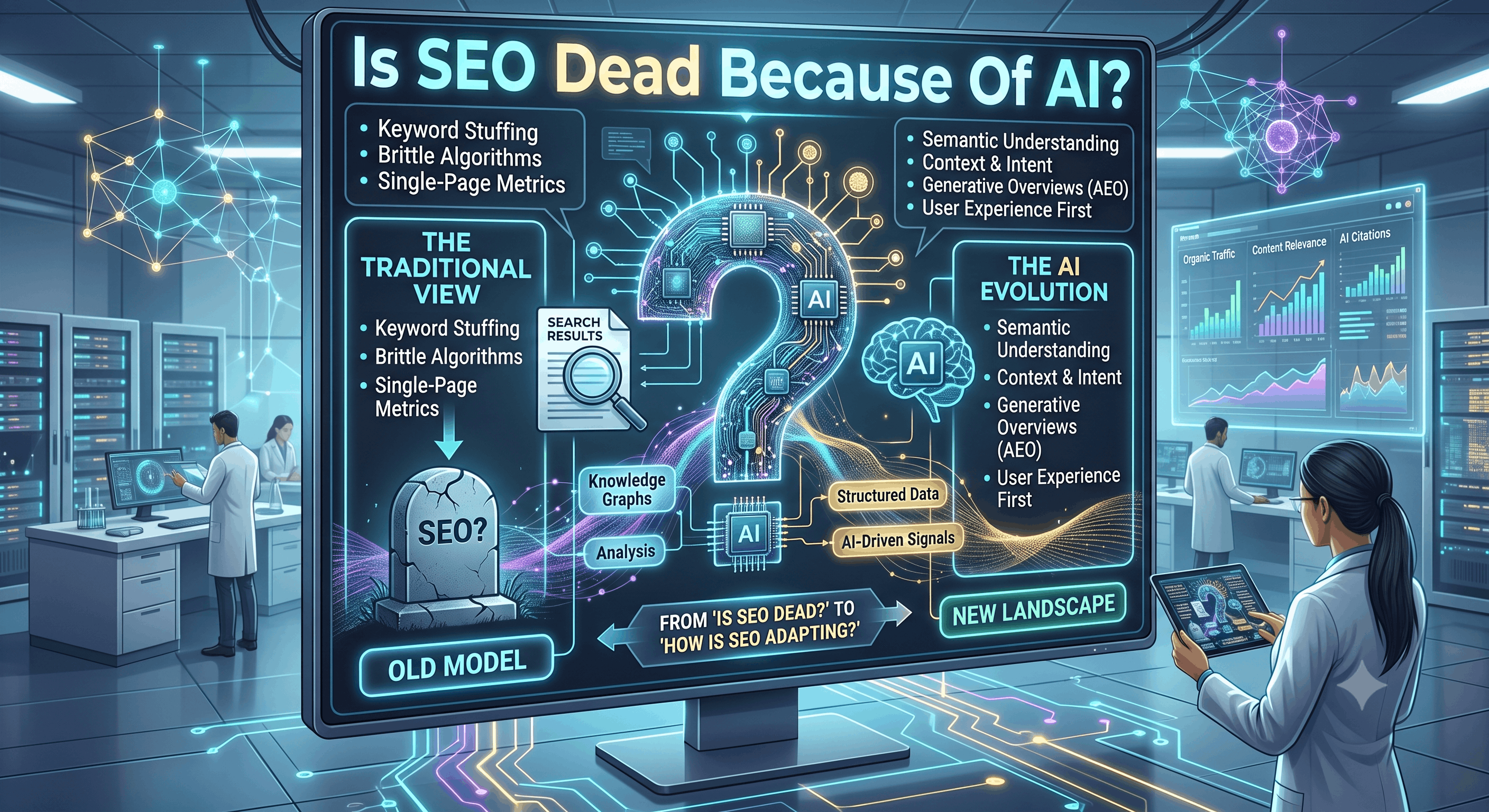
We've heard this question ad nauseum, Is SEO dead because of AI, or some convoluted variation. Simply put, no. The bigger answer is a lot more nuanced. In this article, we talk about what Gartner had to say in 2024 about this shift, and how 2026 was a bit of a revelation.
<h1><strong>Is SEO Dead Because Of AI? We Checked Gartner's 2024 Prediction Against 2026 Data</strong></h1><p></p><p>In February 2024, <a target="_blank" rel="noopener noreferrer nofollow" class="text-primary underline" href="https://www.gartner.com/en/newsroom/press-releases/2024-02-19-gartner-predicts-search-engine-volume-will-drop-25-percent-by-2026-due-to-ai-chatbots-and-other-virtual-agents"><u>Gartner told the industry</u></a> in an incredibly bold claim that traditional search engine volume would drop 25% by 2026 because of AI chatbots. That single prediction is the data point behind most of these incredibly annoying "is SEO dead because of AI" headlines you've read since. Our agents did a deep dive, and here's what they found. </p><p>The short answer: The prediction fell short, but the trend is real. Google held over 90% of the search market through 2026, well short of the collapse the prediction implied. But like we said before, the underlying shift Gartner was pointing at is real: organic click-through rates measurably dropped once AI Overviews entered the picture, even though overall search volume didn't crater. The prediction was directionally right and numerically wrong, and that distinction matters for how you plan.<br><br>Let's keep it real for a second, the Zero-Click trend is becoming more and more of a reality. We covered this a bit in the articles regarding the <a target="_blank" rel="noopener noreferrer nofollow" class="text-primary underline" href="https://discoveraio.com/articles/the-zero-click-fairway-why-local-golf-facilities-cant-afford-to-ignore-ai-search-in-2026">Zero-Click Fairway</a> with Impact Golf Studios, as well as the<a target="_blank" rel="noopener noreferrer nofollow" class="text-primary underline" href="https://discoveraio.com/articles/the-ai-buyers-journey-has-three-stages-brands-only-control-one"> shift in the buyer's journey.</a></p><p>This trend is worth taking a deeper dive into. <br></p><p><strong>Key takeaways</strong></p><ul><li><p>Gartner's 2024 prediction of a 25% drop in search volume by 2026 did not happen as stated. Google maintained over 90% market share through the period.</p></li><li><p>The real, measurable shift was behavioral: organic clicks dropped from 15% to 8% of searches once an AI Overview appeared on the results page.</p></li><li><p>Google absorbed AI into search rather than losing users to standalone chatbots, which is a different outcome than the prediction assumed.</p></li><li><p>The practical course of action is to plan for a reshaped search experience.</p></li></ul><p><br></p><h2><strong>The Prediction That Scared The Industry</strong></h2><img src="https://access.discoveraio.com/storage/v1/object/public/public-assets/email-images/Gartner_prediction.png" alt="A fortune cookie with Gartner's prediction" class="editor-image max-w-full h-auto rounded-lg cursor-pointer transition-all hover:opacity-80" draggable="false" style="max-width: 100%; height: auto;"><p>Gartner's February 2024 press release was specific and testable: search engine volume would drop 25% by 2026 as generative AI tools replaced queries that would previously have gone to a traditional search engine. Alan Antin, the Gartner analyst quoted in the release, framed generative AI as a substitute answer engine rather than a companion to search.</p><p>The prediction spread fast because it gave a number to an anxiety a lot of marketers already had. "AI is going to kill search" is a vague, unfalsifiable claim, and honestly could be seen as ragebait. Our Community Manager sees these, and other related questions on Reddit and Quora all the time, and it's admittedly becoming a stale question to field in a public forum. In our community listening efforts, we've found SEOs who are trying to learn about the best ways to rank and be relevant in AI search in 2026. This article serves a couple of purposes. One, to debunk a claim, and two, to discuss the parts that Gartner got right. </p><h3><br><br><strong>What The Data Actually Shows In 2026</strong></h3><p></p><img src="https://access.discoveraio.com/storage/v1/object/public/public-assets/email-images/AdobeStock_1805226056.jpg" alt="" class="editor-image max-w-full h-auto rounded-lg cursor-pointer transition-all hover:opacity-80" draggable="false" style="max-width: 100%; height: auto;"><p></p><h3><strong>Google Held Its Ground</strong></h3><p><a target="_blank" rel="noopener noreferrer nofollow" class="text-primary underline" href="https://futurefactors.ai/gartner-search-traffic-drop-prediction-2026-reality/"><u>Independent analysis run against the actual 2026 landscape</u></a> found Google maintaining over 90% market share, well past the point where a 25% volume collapse would show up in the numbers. ChatGPT's user base grew substantially over the same period, but that growth happened alongside Google's continued dominance, a different outcome than the original prediction implied.</p><h3><strong>The Real Shift Was Behavioral</strong></h3><p>Here is where the prediction gets more interesting. <a target="_blank" rel="noopener noreferrer nofollow" class="text-primary underline" href="https://www.pewresearch.org/short-reads/2025/07/22/google-users-are-less-likely-to-click-on-links-when-an-ai-summary-appears-in-the-results/"><u>Pew Research tracked real browsing behavior</u></a> from a panel of US adults across March 2025 and found that users clicked a traditional search result just 8% of the time when an AI Overview appeared, compared to 15% when it didn't. That is close to a halving of organic click-through rate, and it happened without search volume collapsing at all.</p><p>Search didn't disappear. It changed what happens after someone runs a query. </p><h3><strong>Where The Prediction Was Right</strong></h3><p>Gartner's underlying instinct, that generative AI would meaningfully change how people use search, was correct. The Pew data is the clearest evidence: a nearly 50% drop in click-through when an AI Overview shows up is not a small thing at all. AI Overviews reshaped what a results page even looks like, and reshaped what "using search" means for a huge share of queries. The landscape of search is collapsing at our feet. Xponent21 talk about how 70 percent of queries now contain an AI Overview. And with that overview, the zero click rate shoots up to 83 percent. </p><p>If your content strategy still assumes a reader who clicks through to a page the way they did in 2022, the underlying behavior Gartner flagged is exactly why that assumption is now wrong, and why you need to make a seismic shift into another direction. </p><p></p><h2><strong>Where It Missed</strong></h2><img src="https://access.discoveraio.com/storage/v1/object/public/public-assets/email-images/AdobeStock_354554934.jpg" alt="A dart missing its target" class="editor-image max-w-full h-auto rounded-lg cursor-pointer transition-all hover:opacity-80" draggable="false" style="max-width: 100%; height: auto;"><p>The part that didn't hold up entirely is the framing of collapse. Google did not lose the search market to standalone AI chatbots. It absorbed generative AI into its own results page, through AI Overviews and AI Mode, and kept the vast majority of query volume flowing through its own ecosystem, sometimes to their own detriment. (Totally not thinking of the <a target="_blank" rel="noopener noreferrer nofollow" class="text-primary underline" href="https://www.mediapost.com/publications/article/416858/google-rivals-seek-damages-after-record-1b-fine.html">lawsuits </a>they're going through in the UK right now for Google giving their own platform preferential treatment.)</p><p>There is also a structural reason full substitution was always going to be harder than the prediction assumed. Processing a generative AI query costs meaningfully more than processing a traditional keyword query, according to <a target="_blank" rel="noopener noreferrer nofollow" class="text-primary underline" href="https://futurefactors.ai/gartner-search-traffic-drop-prediction-2026-reality/"><u>the same 2026 analysis</u></a>. A free, ad-supported search engine can absorb billions of low-cost queries in a way that a compute-intensive AI assistant cannot replicate at the same scale without a different business model behind it. Economics shaped this outcome as much as user preference did. But let's also understand that we're in the era of instant gratification. People want their answers as soon as they input a query. </p><h2><strong>What This Means For Your Strategy</strong></h2><p>Picture this scenario: A marketing director building a 2024 budget case around headlines like Gartner's prediction had a real problem two years later: leadership expected to see organic traffic falling off a cliff, and it didn't. It's a good problem to have, but if you're a company who trusts Gartner's reports at face value, you go with their programming. Explaining why the collapse never arrived, without also admitting the whole premise was wrong, meant walking leadership through the actual behavioral data instead of the headline number. That reframe, format shift instead of extinction, is a stronger budget conversation than either "AI killed search" or "nothing changed." </p><p>Don't build a content plan around search disappearing. Build a content plan around search behaving differently than it did three years ago. Here's a straight-up reality check. </p><ul><li><p>If your traffic reporting still treats every ranking as equally valuable, it's measuring a search experience that no longer exists for a large share of queries.</p></li><li><p>If your content strategy has no answer for "what happens when an AI Overview appears above my result," you're still planning for 2022's search page.</p></li><li><p>If your team's mental model is still "rank or don't rank," you're missing the actual behavioral shift the data shows: getting clicked and getting cited are now two different goals, and both matter.<br></p></li></ul><p>The Prediction That Scared The Industry turned out to be a useful warning shot. It was just aimed in the wrong direction, but we definitely heard the bang. The actual data says something more specific and more actionable: search split into two separate jobs, earning the click and earning the citation, and most strategies still only account for one of them. </p><h2><strong>Frequently Asked Questions</strong></h2><img src="https://access.discoveraio.com/storage/v1/object/public/public-assets/email-images/AdobeStock_293471314.jpeg" alt="" class="editor-image max-w-full h-auto rounded-lg cursor-pointer transition-all hover:opacity-80" draggable="false" style="max-width: 100%; height: auto;"><p></p><h3><strong>Did Google's Search Traffic Actually Drop Because Of ChatGPT?</strong><br></h3><p>No. Google maintained over 90% market share through 2026, the period Gartner's original prediction covered. ChatGPT's usage grew substantially over the same window, but that growth did not come at the expense of Google's overall search volume the way the prediction assumed.</p><h3><strong>Is SEO Dead Because Of AI?</strong></h3><p>No, but the version of SEO built purely around ranking position is far less complete than it used to be. Organic click-through rates drop significantly when an AI Overview appears, which means earning a citation inside the AI-generated answer now matters alongside earning the traditional ranking.</p><h3><strong>What Did Gartner's 2024 Prediction Get Wrong?</strong></h3><p>It predicted a 25% collapse in search volume, framing the shift as chatbots replacing search engines outright. What actually happened was closer to absorption: Google integrated generative AI into its own results pages rather than losing that traffic to standalone AI assistants.</p><h3><br><strong>Should I Stop Investing In Traditional SEO?</strong></h3><p>No. Organic search still drives a large share of overall website traffic. What changed is what "winning" a search result actually looks like now. Plan for both earning the click and earning the AI citation, rather than replacing one goal with the other.</p><p></p><h2><strong>Where To Go From Here</strong></h2><img src="https://access.discoveraio.com/storage/v1/object/public/public-assets/email-images/Where_to_go_from_here__1_.jpg" alt="" class="editor-image max-w-full h-auto rounded-lg cursor-pointer transition-all hover:opacity-80" draggable="false" style="max-width: 100%; height: auto;"><p></p><ul><li><p>For the counterargument to the "AI is replacing SEO" narrative in more depth, <a target="_blank" rel="noopener noreferrer nofollow" class="text-primary underline" href="https://discoveraio.com/articles/ai-isnt-replacing-seo-its-raising-the-bar"><u>AI isn't replacing SEO, it's raising the bar</u></a> builds out that case further.</p></li><li><p>If you want to know what's actually driving marketers to overreact to headlines like this one, <a target="_blank" rel="noopener noreferrer nofollow" class="text-primary underline" href="https://discoveraio.com/articles/the-rush-to-ai-seo-why-most-marketers-are-getting-it-wrong"><u>the rush to AI SEO: why most marketers are getting it wrong</u></a> covers the pattern.</p></li><li><p>For a side-by-side on how AI SEO and traditional SEO actually differ in practice, <a target="_blank" rel="noopener noreferrer nofollow" class="text-primary underline" href="https://discoveraio.com/articles/ai-seo-vs-traditional-seo-key-differences-benefits-strategy"><u>AI SEO vs traditional SEO: key differences, benefits, strategy</u></a> is the fuller breakdown.</p></li></ul><p>The industry will keep producing confident predictions about what AI does to search. Some will be closer to right than others, and almost none of them will get the number exactly correct. The move that actually protects your strategy is checking the data yourself instead of repeating the headline, which is exactly the kind of work DiscoverAIO's community does together every week. If that's useful to you, <a target="_blank" rel="noopener noreferrer nofollow" class="text-primary underline" href="https://discoveraio.com/"><u>DiscoverAIO</u></a> is where that conversation happens.</p><p><br></p>