The AI SEO Glossary: Terms for GEO, AEO, and the New Search Landscape
By Garry M. Callis Jr.
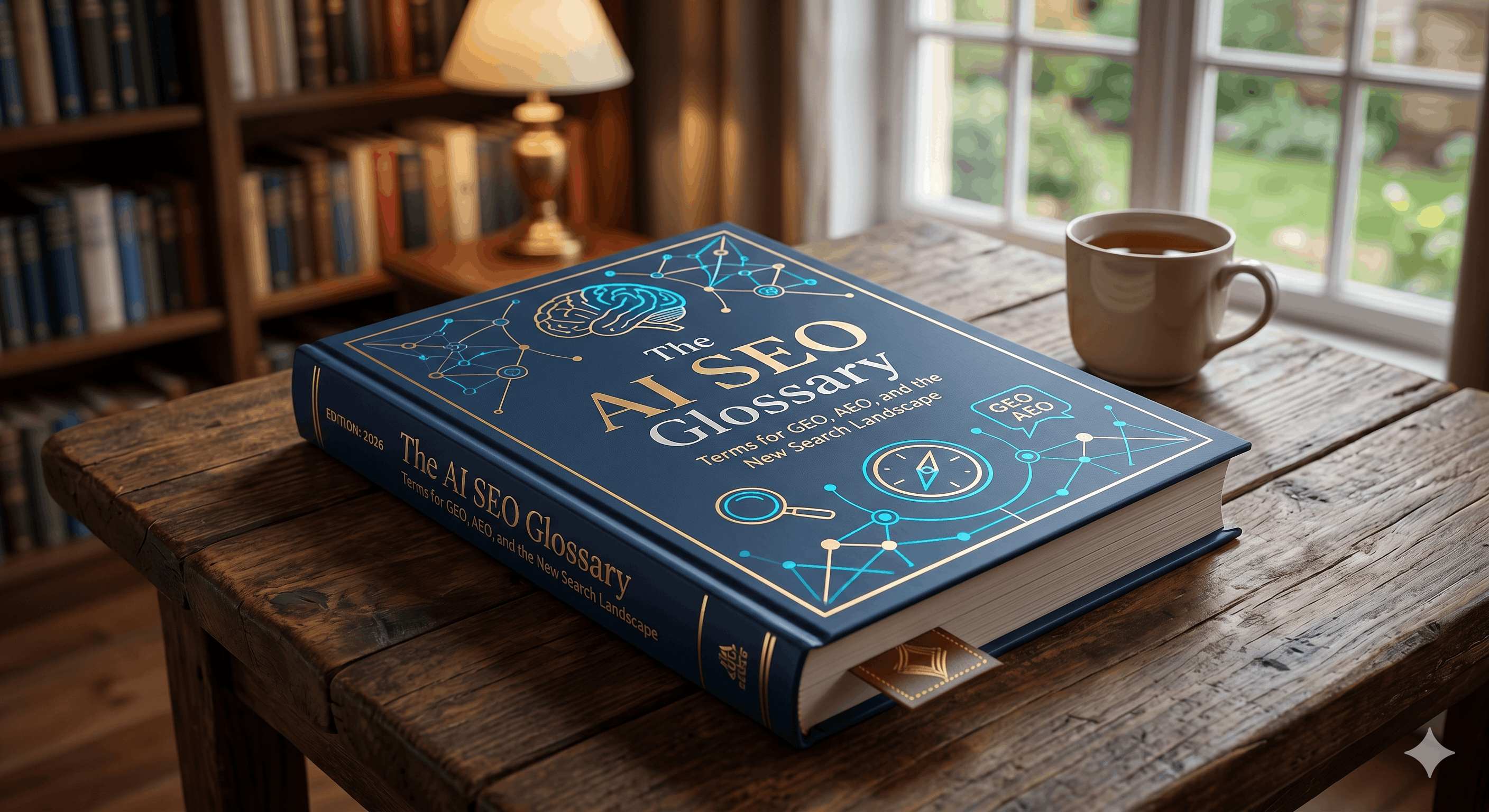
You're reading about AI SEO and the acronyms keep piling up. GEO. AEO. RAG. E-E-A-T. LLMs. Zero-click search. It starts to blur together, your brain starts to overload, and now you feel completely overwhelmed. This AI SEO glossary fixes that. Every term you'll encounter in modern AI-driven search, explained in plain English, with a note on why it actually matters for your content strategy. Bookmark this page. You'll come back to it.
<p></p><h2><strong>Category 1: The Big Three: AI SEO, GEO, and AEO</strong></h2><p></p><p></p><h3><em>These three terms get used interchangeably. They shouldn't. Each refers to a distinct layer of the same problem.</em></h3><p><br></p><h3><strong>AI SEO Explained:</strong><br></h3><p>The practice of optimizing content to appear in, and be cited by, AI-generated search responses. AI SEO builds on traditional SEO principles, authority, relevance, structure, but extends them to AI engines alongside Google's standard index. If a user asks ChatGPT or Perplexity a question and your content gets cited as a source, that's AI SEO working.<br></p><p><strong>Why it matters:</strong> AI-generated responses are the new featured snippet. The real estate is smaller and the citation bar is higher than traditional rankings.</p><p></p><h3><strong>GEO: Generative Engine Optimization Explained</strong></h3><p><br></p><p>GEO is the strategy which concerns optimizing your brand, entity, and content to appear in AI-generated responses across platforms like ChatGPT, Perplexity, Gemini, and Google's AI Overviews. GEO is broader than AEO. It's about your brand being recognized and referenced by AI systems, not just your content answering specific questions.</p><p><strong>Example:</strong> If someone asks Perplexity "what's a good AI SEO platform?" and Discover AIO appears as a recommended resource, that's GEO working. Your brand is in the AI's retrieval layer, not just your page rankings.</p><p><strong>Why it matters:</strong> AI engines are becoming brand-making machines. Brands that get cited consistently build credibility faster than brands that only rank.</p><p><br></p><h3><strong>AEO: Answer Engine Optimization Explained</strong></h3><p></p><p>Optimizing specific pages and passages to directly answer questions that users ask AI engines. AEO is about format and structure: clear, standalone answers that an AI can extract and quote without reading your entire page.</p><p><strong>Example:</strong> Structuring a section with the question as an H2 and the first body sentence as a direct, self-contained answer. "AEO stands for Answer Engine Optimization. It's the practice of structuring content so AI engines can extract and cite clean answers directly from your pages." That sentence works out of context. Most sentences don't.</p><p><strong>Why it matters:</strong> AI engines pattern-match for extractable answers. If your content buries the lead in paragraph four, it won't get cited regardless of how authoritative your domain is. You want the answer to be in the first hundred words of your selection. Quick, easy, accessible. </p><p></p><h3><strong>The difference between the three</strong><br></h3><ul><li><p><strong>AI SEO</strong> is the umbrella discipline</p></li><li><p><strong>GEO</strong> is brand-level visibility in AI responses</p></li><li><p><strong>AEO</strong> is page-level answer extraction</p></li></ul><p></p><h3><em>A complete AI search strategy needs all three. Most brands are currently doing none of them deliberately.</em></h3><p></p><h2><strong>Category 2: AI Search Platforms</strong></h2><p></p><p>These are the platforms your content needs to show up in. Each has different retrieval behaviors, citation tendencies, and user bases.</p><p><br><br><br></p><h3><strong>AI Overview (Google)</strong></h3><p></p><img src="https://access.discoveraio.com/storage/v1/object/public/public-assets/email-images/image_2026-04-22_150025946.png" alt="" class="editor-image max-w-full h-auto rounded-lg cursor-pointer transition-all hover:opacity-80" draggable="false" style="max-width: 100%; height: auto;"><p>Google's AI-generated summary that appears at the top of some search results pages. Formerly called the Search Generative Experience (SGE). The AI Overview pulls from indexed web content and synthesizes an answer, typically citing 3 to 5 sources. Getting cited in an AI Overview is one of the highest-value positions in modern SEO. It's also unpredictable, Google doesn't publish which queries trigger overviews or which sources get selected. It used to be the biggest thing to be cited in the featured snippet or on Page 1 of Google's SERPs, but now the AI Overview is taking that distinction. Bear in mind that 65 percent or more of Google searches have an AI Overview, meaning buyers are converting without clicking at all. We'll get into Zero-Click later. </p><p></p><h3><strong>Perplexity AI</strong></h3><img src="https://access.discoveraio.com/storage/v1/object/public/public-assets/email-images/image_2026-04-22_150505360.png" alt="" class="editor-image max-w-full h-auto rounded-lg cursor-pointer transition-all hover:opacity-80" draggable="false" style="max-width: 100%; height: auto;"><p>An AI-powered search engine that answers questions with inline citations, displayed alongside the synthesized response. Perplexity tends to favor well-structured, authoritative content with clear sourcing and recent publication dates. It's increasingly the default search tool for researchers, marketers, and knowledge workers who want answers, not a list of ten blue links. Perplexity is incredibly detailed, and its Computer function can also handle certain jobs such as generating reports, etc. </p><p></p><h3><strong>ChatGPT Search</strong></h3><p></p><img src="https://access.discoveraio.com/storage/v1/object/public/public-assets/email-images/image_2026-04-22_150740718.png" alt="" class="editor-image max-w-full h-auto rounded-lg cursor-pointer transition-all hover:opacity-80" draggable="false" style="max-width: 100%; height: auto;"><p>OpenAI's web search integration within ChatGPT. When users enable web browsing, ChatGPT retrieves live web content and incorporates it into responses with citations. ChatGPT Search has grown rapidly as a research tool, particularly for complex multi-part questions where users want synthesis and cohesion across multiple sources.</p><p><br></p><h3><strong>Gemini (Google)</strong></h3><img src="https://access.discoveraio.com/storage/v1/object/public/public-assets/email-images/image_2026-04-22_150844166.png" alt="" class="editor-image max-w-full h-auto rounded-lg cursor-pointer transition-all hover:opacity-80" draggable="false" style="max-width: 100%; height: auto;"><p></p><p>Google's AI assistant, integrated across Google Search, Google Workspace, and available as a standalone product. Gemini draws on Google's index and can cite web content in responses. It's particularly relevant for brands already indexed and trusted in Google's ecosystem, Gemini and Google's AI Overviews share some retrieval infrastructure. Gemini also has a whole host of integrations such as its research layer, NotebookLM and other pieces you can use in your tech stack. </p><p><br></p><h3><strong>What are Answer Engines? </strong></h3><p></p><p>A broad category term for any AI-powered platform that responds to natural language questions with synthesized answers rather than a list of links. ChatGPT, Perplexity, Gemini, and Claude all function as answer engines. Traditional Google search is now a hybrid: part link index, part answer engine. The traditional buyers journey has undergone a bit of a shift in the last few years. Of course, the steps from the Awareness to the Decision stage are still the same, but because of the advent of AI, customers or prospects reach those respective stages dramatically quicker, because their queries are being answered instantly, instead of waiting for 10 blue links to give them the answer they needed. </p><p></p><p></p><h3><strong>SGE: Search Generative Experience</strong></h3><p></p><p>Google's deprecated internal name for what launched publicly as AI Overviews. You'll still see "SGE" in older research papers, marketing materials, and industry articles from 2023 to early 2024. It refers to the same technology. If you see SGE, read it as AI Overviews.</p><p><br></p><h2><strong>Category 3: Content Strategy and Optimization Concepts</strong></h2><p></p><h3><em>These are the terms that describe how content gets structured, evaluated, and selected by AI systems.</em></h3><p><br></p><h3><strong>Topical Authority</strong></h3><p></p><p>The degree to which a website is recognized as a trusted, comprehensive source on a specific topic. Topical authority is built through content depth, internal linking, and consistent coverage of a topic cluster over time. AI engines weigh topical authority heavily when selecting sources to cite. Third party mentions are also instrumental here. When someone is willing to talk about you or your brand and AI can cite it, it increases your credibility and citation layer exponentially. </p><p><strong>Example:</strong> A site with 30 interconnected articles about AI SEO, covering definitions, tools, case studies, tutorials, and measurement, has stronger topical authority than a site with one excellent article on the same topic. The network of content matters as much as any individual piece.</p><p></p><h3><strong>Content Cluster / Pillar Page Strategy</strong><br></h3><p>A content architecture where one comprehensive "pillar" page covers a broad topic and multiple "cluster" pages cover specific subtopics, all internally linked together. Content clusters build topical authority and signal to AI engines that a site owns a subject area rather than covering it occasionally. It acts as a rabbit hole of sorts, where someone can look at an article or piece of work you've written, and now they get to see into the content ecosystem you've written around a single topic cluster. When thinking of what to write, pick a topic, and write your flagship article. Then spin all of your subsequent articles in that cluster off of your flagship, thus generating a flywheel. </p><p></p><h3><strong>Semantic SEO</strong></h3><p></p><p>Optimizing content around the meaning and context of search queries, not just exact keyword matches. Semantic SEO accounts for synonyms, related concepts, and the relationships between topics. AI engines are inherently semantic. They understand intent and context, not just keyword frequency, which is why keyword stuffing has been declining as a tactic for years. When you're able to answer questions directly, it mitigates friction. </p><h3><strong>Conversational Search</strong><br></h3><p>Queries phrased as natural language questions rather than keyword strings. "What's the best way to optimize for AI search?" instead of "AI search optimization tips." Conversational search is the default mode for AI engines and is growing on traditional search platforms too, driven by voice interfaces and AI assistants becoming primary entry points. You’ll find that ChatGPT is more of a conversational LLM than the other ones. A point also should be made here about prompting. When you're able to create and iterate prompts though natural language, it gets incredibly easy to replicate. For example, if you're looking to create a workflow, tell your platform your end goal with natural language, and have it work backwards. </p><p><br></p><h3><strong>Zero-Click Search</strong></h3><p></p><p>A search where the user gets their answer from the SERP or AI response without clicking through to any website. AI Overviews and featured snippets both drive zero-click behavior. Zero-click doesn't mean your content failed. A citation in an AI Overview still builds brand awareness and authority even without a click. It does mean traffic metrics alone undercount your actual AI search impact.</p><p><br></p><h3><strong>Featured Snippet</strong></h3><p></p><p>A boxed excerpt at the top of Google search results that directly answers a query, displayed above organic results. Featured snippets are the pre-AI version of what AEO targets. They reward identical formatting principles: clear questions, direct first-sentence answers, and concise structure. Most AEO tactics also improve featured snippet capture, so optimizing for one typically helps the other. AI Overviews are effectively the equivalent of what the featured snippet is, but enables brands to be seen/cited in AI powered search results. <br></p><h3><strong>Entity SEO / Entity-Based SEO</strong><br></h3><p>Optimizing your brand, people, products, and locations as recognized "entities" in knowledge graphs and AI training data. When Google and AI engines understand who you are as an entity, not just what keywords you rank for, they can include you in responses even when your specific pages aren't the cited source.</p><p><strong>Example:</strong> Discover AIO being recognized as a distinct entity in Google's Knowledge Graph means it can appear in AI responses about AI SEO platforms without requiring a specific page to rank for the query. <br>A little experiment you can do is to look yourself up on multiple platforms and see if the information that's out there about you is congruent and accurate. </p><p></p><h3><strong>Search Intent</strong></h3><p></p><p>The underlying goal a user has when running a search. The four standard intent types are; informational (learn something), navigational (find something), commercial (research something), and transactional (ready to buy something). AI SEO adds a fifth layer worth tracking: conversational intent, where the user wants a dialogue and synthesis, not a single document. Traditional SEO practices are now foundational in nature. You need these things just to have a decent chance of showing up once you have augmented it with AI SEO strategy and tactics. </p><p></p><h3><strong>Co-Citation</strong></h3><p></p><p>When multiple sources cite or reference a brand or piece of content in the same context, increasing that brand's perceived authority on the topic. AI engines pick up on co-citation patterns, which is why getting mentioned across multiple credible sites matters beyond traditional backlink counts.<br></p><h3><strong>Unlinked Brand Mentions</strong><br></h3><p>References to your brand name on other websites that don't include a hyperlink. AI engines can recognize and weigh unlinked mentions as authority signals, which traditional link-counting algorithms have largely ignored. Getting mentioned in industry publications, podcast show notes, and active online communities builds GEO value even without a link pointing back to you. 3rd party mentions, are absolutely key for getting AI to cite you. Word of mouth travels fast, and AI can augment that exponentially. </p><p></p><h3><strong>Quotable Sentence / Snippet Optimization</strong></h3><p></p><p>Writing specific sentences designed to be extractable and citable by AI engines without additional context. A quotable sentence stands alone: subject, verb, clear meaning. It doesn't rely on the surrounding paragraph to make sense.</p><p></p><p><strong>Quotable:</strong> "AEO is the practice of structuring content so AI engines can extract and cite clean answers directly from your pages."</p><p><strong>Not quotable:</strong> "As we discussed above, this approach has become increasingly important in recent years for the reasons outlined in the previous section."</p><p>Audit your most important pages for quotable sentences on every key claim. If you can't find them, rewrite the opening sentences of each H2 section until they stand alone.</p><p><br></p><h2><strong>Category 4: Technical Foundations</strong></h2><h3></h3><h3><em>These terms describe the underlying technology and signals that AI systems use to evaluate and retrieve content.</em></h3><p></p><h3><strong>E-E-A-T: Experience, Expertise, Authoritativeness, Trustworthiness</strong></h3><p><br></p><p>Google's quality evaluator framework, applied to both content and the entities that produce it. AI engines use similar signals. The first E (Experience) was added in 2022, distinguishing first-hand experience from claimed expertise. A travel writer who has been to 40 countries has experience. A writer who summarizes other travel blogs has expertise at best.</p><p>For AI SEO, E-E-A-T signals include: author bylines with verifiable credentials, linked social profiles or personal sites, citations in other credible publications, accurate and sourced claims throughout the content, and an identifiable publishing entity behind the site. The <a target="_blank" rel="noopener noreferrer nofollow" class="text-primary underline" href="https://discoveraio.com/courses">AI SEO Leadership Blueprint course</a>, offered here on Discover AIO, covers E-E-A-T extensively in the very first chapter of the course. </p><p><br></p><h3><strong>Schema Markup / Structured Data</strong></h3><img src="https://access.discoveraio.com/storage/v1/object/public/public-assets/email-images/image_2026-04-22_164858015.png" alt="" class="editor-image max-w-full h-auto rounded-lg cursor-pointer transition-all hover:opacity-80" draggable="false" style="max-width: 100%; height: auto;"><p>Code added to a web page that explicitly tells search engines what the content means, not just what it says. Schema types relevant to AI SEO include FAQ schema, Article schema, HowTo schema, and Organization schema. Schema markup makes your content significantly easier for AI parsers to interpret and categorize correctly.<br></p><h3><strong>FAQ Schema</strong></h3><p></p><p>A specific type of structured data that marks up a page's question-and-answer content in a machine-readable format. When implemented correctly, FAQ schema makes it significantly easier for AI engines to identify and extract answers from your pages. It's one of the highest-leverage technical moves for AEO because it directly serves the format AI systems are optimized to cite.</p><p><br></p><h3><strong>RAG: Retrieval-Augmented Generation</strong></h3><p></p><p>The technical architecture most AI search tools use: a large language model retrieves relevant documents from a live index, then generates a response by synthesizing that retrieved content. RAG is why your content needs to be indexed, clearly structured, and recently updated. The AI isn't pulling from memorized training data when it cites your page. It's pulling your content live and feeding it into its response pipeline.<br></p><p><strong>Why it matters for content strategy:</strong> RAG systems favor content that's well-structured, well-sourced, and fresh. Vague or unsourced content is less likely to be retrieved in the first place.</p><p></p><h3><strong>LLM: Large Language Model</strong></h3><p></p><p>The AI model type underlying tools like ChatGPT, Claude, and Gemini. LLMs are trained on massive text datasets and generate human-like responses by predicting likely sequences of words. LLMs don't "know" facts the way a database does. They generate text based on patterns learned during training. This is why high-quality, clearly sourced content shapes what AI systems produce, and why low-quality content that gets cited spreads misinformation. Note that different LLMs specialize in different things. So as you’re researching these, think of it as a toolbelt that can be used for different use cases.</p><p></p><h3><strong>Knowledge Graph</strong></h3><p></p><p>A structured database of entities and their relationships, maintained by Google and other AI systems. If your brand, products, or key people are in Google's Knowledge Graph, AI engines can reference them independently of your page rankings. Building Knowledge Graph presence is a GEO strategy, not just an SEO tactic. It's how brands move from "content that ranks" to "brand that gets cited."<br></p><h3><strong>Passage Indexing</strong></h3><p></p><p>Google's ability to index and rank specific passages within a page, not just the page as a whole. Relevant to AEO because it means a single strong answer buried in a long article can still get extracted and surfaced. Passage indexing works alongside good formatting, not instead of it. Clear headings help Google identify where each passage begins and ends.</p><p></p><h3><strong>Training Data Cutoff</strong></h3><p></p><p>The date after which an AI model's training data ends. LLMs don't know about events or content published after their cutoff unless they use RAG to retrieve live content. For RAG-based systems like Perplexity and ChatGPT Search, this matters less. For static LLM responses (no web browsing enabled), content published before the cutoff date has an advantage. Consistent publishing and freshness signals matter more as RAG becomes the dominant retrieval architecture.</p><p><br></p><h2><strong>Category 5: Metrics and Measurement</strong><br></h2><h3><em>The measurement layer for AI SEO is still being built. These are the metrics and concepts practitioners are tracking now.</em></h3><p></p><p></p><h3><strong>AI Citation</strong></h3><p></p><p>When an AI engine references your content as a source in its response. AI citations are the new backlinks: an authority signal and a traffic driver rolled into one. Tracking which pages earn AI citations, from which platforms, and for which queries is an emerging measurement practice that most analytics tools don't yet handle natively. Purpose-built tools (including Discover AIO's new Community Member, <a target="_blank" rel="noopener noreferrer nofollow" class="text-primary underline" href="https://olympuslab.uk">Olympus Lab</a>) are filling that gap.<br></p><h3><strong>Share of Voice (AI Search)</strong></h3><p></p><p>The percentage of AI-generated responses in your topic area that cite or mention your brand. Traditional share of voice measures search rankings. AI share of voice measures citation frequency across answer engines. A brand can have strong traditional share of voice and near-zero AI share of voice, which is increasingly the scenario for brands that haven't adapted their content strategy.</p><h3><strong>Zero-Click Rate</strong></h3><p></p><p>The percentage of searches in a category that result in no website visit. As AI Overviews expand, zero-click rates rise across most informational query types. Brands that track this separately from organic CTR get a clearer picture of whether AI is cannibalizing traffic or simply shifting where brand exposure happens. A rising zero-click rate with stable brand mention volume is a different problem than a rising zero-click rate with declining brand mentions.</p><p></p><h3><strong>Content Freshness</strong></h3><p></p><p>How recently a piece of content was published or significantly updated. AI engines, particularly RAG-based systems, factor freshness into retrieval. For topics that evolve quickly (AI search itself, industry news, research findings), freshness is a hard ranking factor. Adding a visible last-updated date, publishing meaningful updates quarterly, and removing stale claims maintains freshness signals without requiring a full rewrite each time. Xponent 21 has a few articles referring to a concept they call "<a target="_blank" rel="noopener noreferrer nofollow" class="text-primary underline" href="https://xponent21.com/insights/faq/what-is-good-farmer-seo/">Good Farmer SEO</a>" Good Farmer explains more in-depth why keeping your content fresh is great, not only for citations, but it also signals to readers and brands that you actually care about the topics you're talking about. </p><p><br><br><br></p><h3><strong>E-E-A-T Signal Strength</strong></h3><p></p><p>Not a literal numeric score Google publishes, but the collective assessment applied to content and sites. High E-E-A-T content has: a clearly identified author with verifiable credentials, accurate claims supported by named sources or data, external citations from other credible publications, and an identifiable brand or organization behind the site. Each signal compounds. A named expert author on a site with a verified Google Business Profile on a domain with consistent external citations outperforms anonymous content on most AI search platforms.</p><p></p><h2><strong>TL;DR</strong></h2><p></p><ul><li><p>AI SEO, GEO, and AEO are three overlapping disciplines focused on visibility in AI-generated search results</p></li><li><p>The platforms have changed (ChatGPT, Perplexity, Gemini alongside Google), but the fundamentals of trust, clarity, and authority still drive what gets cited</p></li><li><p>Structured content, entity signals, and direct answers are the main levers</p></li><li><p>This glossary covered multiple terms across multiple categories: core concepts, AI search platforms, content strategy, technical foundations, and measurement</p></li></ul><p></p><h2><strong>What to Do With This Information</strong><br></h2><p>Knowing the terms is the starting point. The next move is auditing your existing content against these principles.</p><ul><li><p>Do your most important pages have quotable sentences for the key questions in your niche?</p></li><li><p>Are your FAQ sections marked up with FAQ schema?</p></li><li><p>Does your brand appear as a recognized entity in Google's Knowledge Graph?</p></li><li><p>Are you tracking AI citations, not just organic traffic?</p></li><li><p>Do your author bylines link to verifiable profiles that establish E-E-A-T?</p></li></ul><p></p><p>Most brands can answer "no" to at least three of those. That's the gap this discipline exists to close.</p><p>Discover AIO is built specifically for this kind of AI-era SEO work. Members get access to AEO tracking tools, a library of content optimization guides, a whole ecosystem of articles, and a community of practitioners running the same playbook in their own categories. If you want to go deeper than a glossary, that's where the work happens. The Discover AIO community is doing this kind of work every single day. Whether it's testing and iterating AI tools, doing AI SEO work for clients or themselves, vibe coding apps for release to the market, or any other AI marketing application, Discover AIO is the place to be if you're forward-thinking, and looking to be in the room with liked-minded folks who are at the vanguard of marketing. Join us, join the <a target="_blank" rel="noopener noreferrer nofollow" class="text-primary underline" href="https://discoveraio.com/directory">Member Directory</a> and join the Membership Calls that we have every 2nd Wednesday of every month. </p>