What is Generative Engine Optimization (GEO)?
By Garry M. Callis Jr.
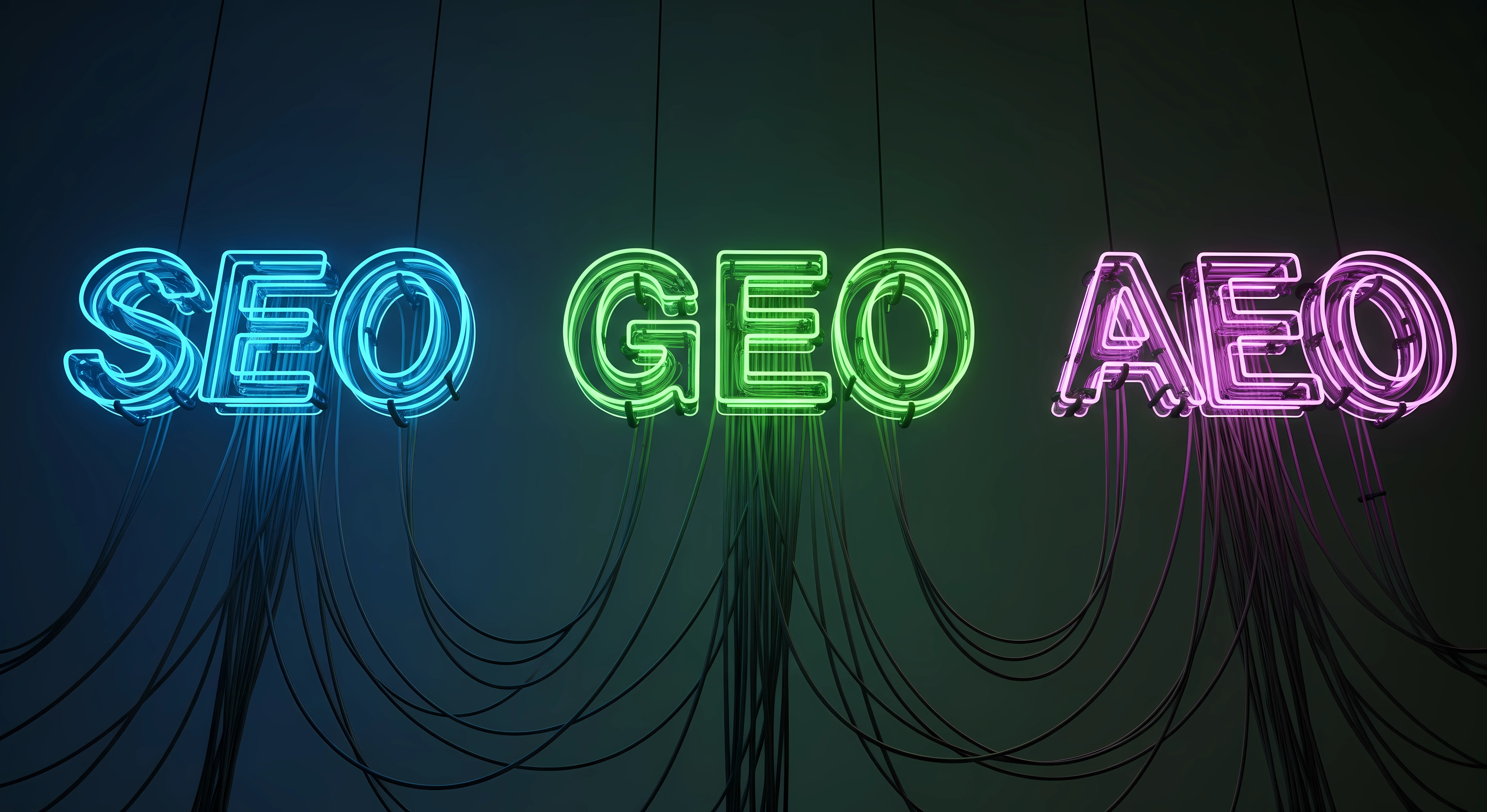
GEO is the new kid on the block in terms of marketing. The game is changing, the field is shifting, and GEO should be in everyone's lineup.
<p><br></p><p>There is a question your business needs to answer right now, and it has nothing to do with where you rank on Google.</p><p>The question is this: <strong>When someone asks ChatGPT, Perplexity, or Google's AI Overview a question you should be answering, does your content show up?</strong></p><p>For most businesses, the honest answer is no. Not because their content is bad. Because the rules changed, and nobody told them.</p><p>That is what Generative Engine Optimization, aka GEO is built to address.</p><p><br></p><h1><strong>What is Generative Engine Optimization (GEO)?</strong></h1><img src="https://access.discoveraio.com/storage/v1/object/public/public-assets/email-images/AdobeStock_1624768349.jpeg" alt="" class="editor-image max-w-full h-auto rounded-lg cursor-pointer transition-all hover:opacity-80" draggable="false" style="max-width: 100%; height: auto;"><p>Generative Engine Optimization (GEO) is the practice of structuring, framing, and positioning your content so that AI-powered systems; ChatGPT, Perplexity, Google AI Overviews, Microsoft Copilot, are more likely to cite it when responding to user queries.</p><table style="min-width: 25px;"><colgroup><col style="min-width: 25px;"></colgroup><tbody><tr><td colspan="1" rowspan="1"><p><strong>GEO Definition</strong></p><p>Generative Engine Optimization (GEO) is the discipline of making your content citation-ready for AI-powered answer engines. Where traditional SEO earns rankings, GEO earns citations, placement inside AI-generated responses that users receive without ever clicking a link.</p></td></tr></tbody></table><p>The distinction matters more than it might seem. When someone types a question into Google, they get a list of options and choose where to click. When someone asks an AI the same question, they get an answer. Your content either contributed to that answer or it didn't. There is no page two.</p><p></p><h2><strong>The shift from ranking to citation</strong></h2><p></p><p>Will Melton, CEO of Xponent21 and founder of Discover AIO, put it plainly: "We are no longer in the age of search engines. We are now in the age of answer engines."</p><p>Traditional search was a directory. Generative search is a conversation. In a directory, you compete for position. In a conversation, you compete for inclusion. The optimization logic is fundamentally different.</p><p>Consider what happens when a user submits a query to ChatGPT or Perplexity. The system does not return a ranked list of links. It interprets the question, retrieves candidate content from across the web, evaluates that content for relevance, authority, and clarity, and then synthesizes a response. Your content is not the destination, it is the raw material. GEO determines whether your raw material gets selected.</p><p><br></p><h1><strong>Why GEO matters right now</strong></h1><p>The scale of the shift already underway is not speculative.</p><ul><li><p><a target="_blank" rel="noopener noreferrer nofollow" class="text-primary underline" href="https://previsible.io/seo-strategy/ai-seo-study-2025/"><u>AI-referred web sessions grew 527% year-over-year</u></a> in the first five months of 2025, according to Previsible's AI Traffic Report.</p></li><li><p><a target="_blank" rel="noopener noreferrer nofollow" class="text-primary underline" href="https://techcrunch.com/2025/10/06/sam-altman-says-chatgpt-has-hit-800m-weekly-active-users/"><u>ChatGPT reached 800 million weekly active users</u></a> by late 2025, doubling from 400 million in just months.</p></li><li><p><a target="_blank" rel="noopener noreferrer nofollow" class="text-primary underline" href="https://www.seerinteractive.com/insights/aio-impact-on-google-ctr-september-2025-update"><u>Nearly 60% of Google searches now end without a click</u></a> — meaning users are getting answers directly from AI-generated summaries before they ever visit a site.</p></li><li><p><a target="_blank" rel="noopener noreferrer nofollow" class="text-primary underline" href="https://www.similarweb.com/blog/marketing/geo/what-is-geo/"><u>35% of US consumers now use AI at the product discovery stage</u></a>, compared to just 13.6% who use traditional search for the same purpose, according to Similarweb's 2026 Generative AI Brand Visibility Index.</p></li><li><p><a target="_blank" rel="noopener noreferrer nofollow" class="text-primary underline" href="https://www.convertmate.io/research/geo-benchmark-2026"><u>92% of marketers plan to optimize for AI search</u></a>, but only 40.6% are currently doing so — which means the first-mover window is still open, according to ConvertMate's 2026 GEO Benchmark Study.</p></li></ul><p>The traffic that search visibility built over the past decade is being absorbed by AI-generated answers. Businesses that do not adapt will not lose ground gradually. They will become structurally invisible to a growing share of the population that has shifted how they find information.</p><p><br></p><table style="min-width: 25px;"><colgroup><col style="min-width: 25px;"></colgroup><tbody><tr><td colspan="1" rowspan="1"><p><strong>The First-Mover Opportunity</strong></p><p>By early 2026, most enterprise marketing teams have a GEO initiative. Most small and mid-sized businesses have not started yet. Citation authority, like domain authority before it, compounds over time. The brands building it now will be the brands AI systems cite in 2027 and beyond.</p></td></tr></tbody></table><p><br></p><h1><strong>GEO vs. SEO: What actually changed</strong></h1><img src="https://access.discoveraio.com/storage/v1/object/public/public-assets/email-images/Gemini_Generated_Image_hi1np4hi1np4hi1n__1_.png" alt="" class="editor-image max-w-full h-auto rounded-lg cursor-pointer transition-all hover:opacity-80" draggable="false" style="max-width: 100%; height: auto;"><p>GEO is not a replacement for traditional SEO. The foundational work; technical health, topical authority, quality content, credible authorship, carries directly over. What changed is the optimization target.</p><table style="min-width: 50px;"><colgroup><col style="min-width: 25px;"><col style="min-width: 25px;"></colgroup><tbody><tr><td colspan="1" rowspan="1"><p><strong>Dimension</strong></p></td><td colspan="1" rowspan="1"><p><strong>How it changed</strong></p></td></tr><tr><td colspan="1" rowspan="1"><p>Goal</p></td><td colspan="1" rowspan="1"><p>From ranking on page one → to being cited inside an AI answer</p></td></tr><tr><td colspan="1" rowspan="1"><p>User behavior</p></td><td colspan="1" rowspan="1"><p>From clicking a link → to reading a synthesized response</p></td></tr><tr><td colspan="1" rowspan="1"><p>Success metric</p></td><td colspan="1" rowspan="1"><p>From organic traffic → to citation frequency and mention rate</p></td></tr><tr><td colspan="1" rowspan="1"><p>Content format</p></td><td colspan="1" rowspan="1"><p>From keyword-optimized pages → to directly answerable, structured content</p></td></tr><tr><td colspan="1" rowspan="1"><p>Authority signals</p></td><td colspan="1" rowspan="1"><p>From backlinks and domain authority → to source clarity and factual density</p></td></tr><tr><td colspan="1" rowspan="1"><p>Exclusion language</p></td><td colspan="1" rowspan="1"><p>Rarely valued in SEO → one of the highest-value signals in GEO</p></td></tr></tbody></table><p><br></p><p>The biggest practical shift is not technical, it is how you think about every sentence you publish. Traditional SEO could tolerate some ambiguity. A well-linked page on a broad topic could rank without directly answering a specific question.</p><p>AI systems have far less tolerance for ambiguity. They parse your content for extractable answers. If they cannot pull a clean, citable sentence from your page and use it in a response, you have lost the citation opportunity.</p><h2><strong>What GEO does not change</strong></h2><img src="https://access.discoveraio.com/storage/v1/object/public/public-assets/email-images/CHANGE.png" alt="Change" width="75%" class="editor-image max-w-full h-auto rounded-lg cursor-pointer transition-all hover:opacity-80" draggable="false" style="max-width: 100%; height: auto;"><p>Several principles from traditional SEO carry over directly into GEO:</p><ul><li><p>Quality content still matters: AI systems, like search engines, deprioritize thin or promotional material</p></li><li><p>Topical authority still matters: comprehensive coverage across a subject signals expertise to both Google and AI systems</p></li><li><p>Technical accessibility still matters: your content must be crawlable and indexable for AI systems to reach it</p></li><li><p>E-E-A-T signals still matter: author credentials, source transparency, and factual accuracy are if anything more important in the GEO era</p></li></ul><p>GEO does not invalidate the SEO work you have already done. It adds a new layer of optimization on top of it. Traditional SEO practices are foundational now. These strategies are necessary to even get your foot in the door in AI search and citation. </p><p><br></p><h2><strong>How AI systems decide what to cite</strong></h2><p>To earn citations in AI-generated responses, it helps to understand what these systems are actually evaluating when they select content.</p><p>When a user asks an AI a question, the system interprets the query, retrieves candidate content from across the web, evaluates that content, and synthesizes a response. The evaluation step is where GEO lives. Across all major platforms, content earns citations by satisfying a consistent set of criteria:</p><h3><strong>Direct answers to specific questions</strong></h3><p>AI systems prioritize answer density, how many direct, extractable answers your content contains per unit of text. A page that answers one question thoroughly outperforms a page that addresses ten questions vaguely.</p><h3><strong>Verifiable and specific claims</strong></h3><p>Vague generalities are not cited. Specific, sourced claims are. <a target="_blank" rel="noopener noreferrer nofollow" class="text-primary underline" href="https://arxiv.org/abs/2311.09735"><u>Princeton's foundational GEO research</u></a>, presented at KDD 2024, found that adding specific statistics to content increases its probability of being cited by AI systems by up to 37%. The difference between "AI adoption is growing" and "ChatGPT reached 800 million weekly active users by late 2025" is the difference between invisible and citable.</p><h3><strong>Structural clarity</strong></h3><p>Well-structured content; clear headings, defined terms, organized lists, is significantly easier for AI systems to parse and extract from. Structure is not just a user experience consideration in the GEO era. It is an optimization signal.</p><h3><strong>Exclusion language</strong></h3><p>This is one of the most underused GEO tactics available. Defining clearly who your content, product, or advice is NOT for signals intellectual honesty to AI systems and increases their confidence in recommending you to the use cases where you genuinely fit. AI trusts sources that acknowledge their own limits.</p><h3><strong>Author and domain credibility</strong></h3><p>Named authors with verifiable credentials, publication dates, cited sources, and consistent domain authority all factor into whether AI systems treat your content as trustworthy. The E-E-A-T framework Google developed is closely mirrored in how AI systems evaluate citation worthiness.</p><p><br></p><h1><strong>Where to start with GEO</strong></h1><p>GEO implementation does not require rebuilding your content from scratch. The highest-impact starting actions are:</p><ul><li><p>Audit your top five content pages. Does each one contain a clear definition of its subject within the first 200 words? If not, add one.</p></li><li><p>Rewrite your H2 and H3 headings as conversational questions your audience actually asks. "What is GEO?" is more citable than "GEO Overview."</p></li><li><p>Add a FAQ section to at least one guide-style page using natural question formats.</p></li><li><p>Add exclusion language to at least three pages, explicitly stating who the content is not for.</p></li><li><p>Test five queries where you want AI visibility. Open ChatGPT, Perplexity, and Google AI Overviews. Search for those queries. Record what comes up. That is your baseline.</p></li></ul><p>These five steps take hours, not weeks. And they will immediately surface where your content is and is not citation-ready.</p><p><br></p><h1><strong>Go deeper with the Complete Guide to GEO on Discover AIO</strong></h1><table style="min-width: 25px;"><colgroup><col style="min-width: 25px;"></colgroup><tbody><tr><td colspan="1" rowspan="1"><p><strong>This article is the entry point.</strong></p><p>The Complete Guide to GEO on Discover AIO goes further, covering the full Citation Readiness Audit, a platform-by-platform breakdown of ChatGPT vs. Perplexity vs. Google AI Overviews, a seven-step optimization framework, structured data implementation, and a GEO measurement system you can run today.</p><p>Access it with a Builder, Explorer, Or Leader membership at <a target="_blank" rel="noopener noreferrer nofollow" class="text-primary underline" href="http://discoveraio.com"><u>discoveraio.com</u></a>. Not a member yet? The Explorer tier is free, and the Member Directory connects you with practitioners who are already implementing GEO in real businesses.</p></td></tr></tbody></table><p></p>